Hello, and welcome!
I am a linguist who conducts research and documentation projects on Trans-Himalayan languages (also known as Tibeto-Burman or Sino-Tibetan). My work focuses on phonology, morphology, historical linguistics, linguistic typology, and language documentation.
I am currently a lecturer-researcher in linguistics at Université Bordeaux Montaigne (UBM) and an associate member of the research laboratories Langues et Cultures à Tradition Orale (LACITO) and Cognition, Langues, Langage, Ergonomie (CLLE) of the French National Centre for Scientific Research (CNRS).
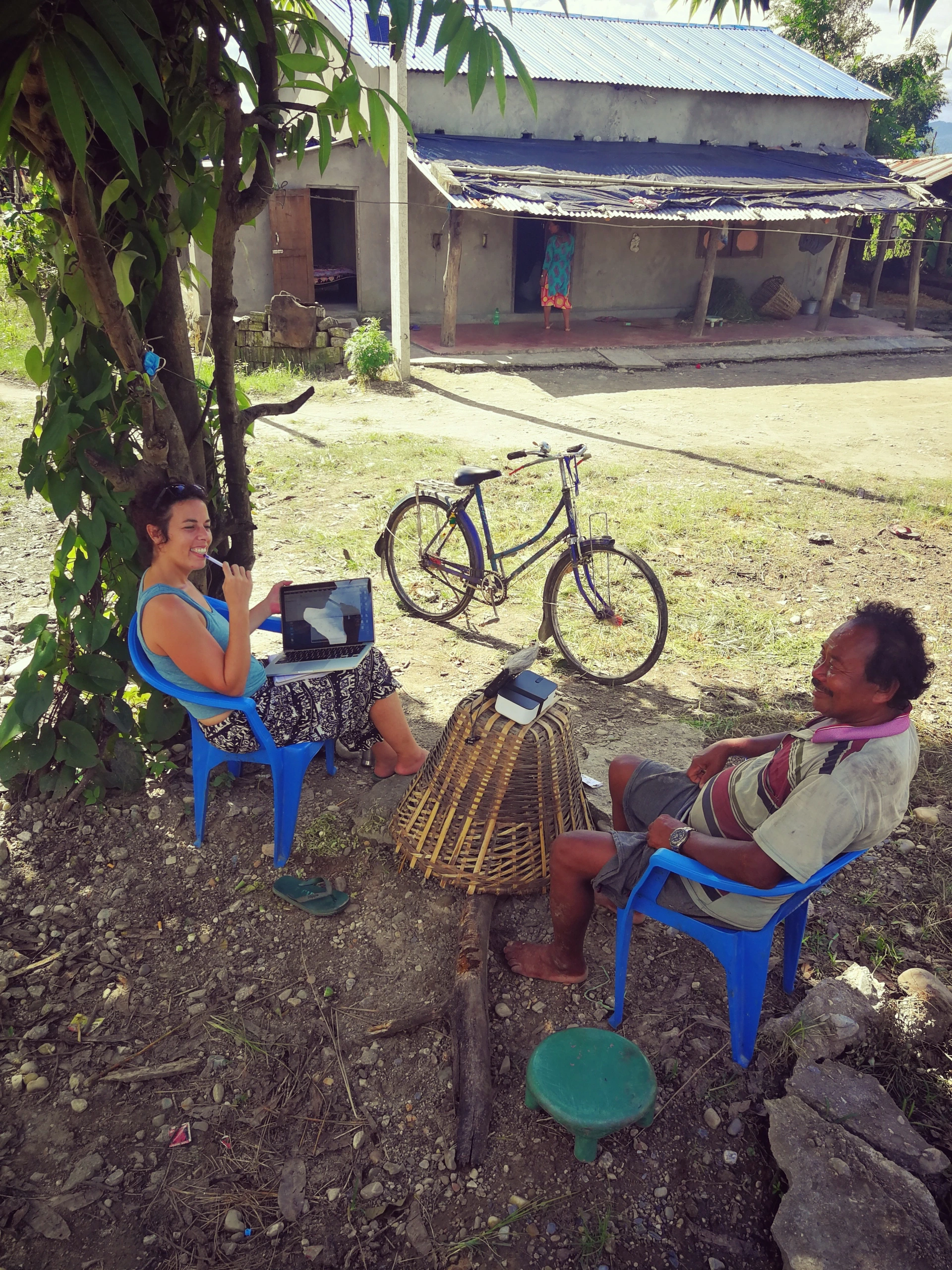
For over a decade, I have been working in close collaboration with speakers of four Himalayan languages spoken in western and central Nepal, including Magar, Khamci, Bhoto, and Chepang.
My approach to the study of language is functional, usage-based, constructional, and comparative, to provide both synchronic and diachronic analyses. My work seeks to understand the current use of phonological and morphosyntactic structures, their typological specificities, and evolutionary dynamics. My research also draws on the history and anthropology of the Himalayan region.
The research and documentation projects I have carried out received funding from grants awarded by the JSPS (Cultural Anthropology and Folklore), the Endangered Language Fund (ELF) and the National Science Foundation (NSF).
My Ph.D. dissertation, titled The Chepang language: Phonology, nominal and verbal morphology – synchrony and diachrony of the varieties of the Lothar and Manahari Rivers (2022), offers the first in-depth analysis of the phonological and morphosyntactic structures of Chepang varieties spoken in south-central Nepal. This dissertation contributes to research in typology and historical linguistics by examining, among other things, the laryngeal features involved in tonogenesis, the historical development of verbal morphology and its use in synchrony within a non-canonical direct-inverse system, as well as the role of referentiality, deixis, and attention in argument indexing and evidentiality marking.
Nepal has become my second home and I am deeply grateful to all the people I met and shared their lives with. Nepal is also the land where I met my life partner and where our family was born.